Juice Yield, Produce Weight & Batch Cost Calculator
Estimate exact juice yield in fl oz and ml, number of bottles per batch, cost per serving, and masticating vs. centrifugal output across 52 fruits and vegetables.
Quick Answer. Most whole produce yields 45% to 78% juice by weight (about 7 to 12 fl oz per pound). A typical 5 lb batch yields 35 to 60 fl oz (1,035–1,775 ml), or 2 to 3.7 standard 16 oz bottles at $1.60–$3.75 per bottle—with masticating juicers pulling 7% to 33% more liquid than centrifugal models.
Mixing several ingredients in one recipe? Switch to the Multi-Ingredient Produce Yield Calculator to add carrots, apples, cucumber, and greens together in a single batch estimate.
1. Batch & Juicer Inputs
2. Estimated Yield & Batch Cost
Masticating vs. Centrifugal Yield Comparison
—
Choosing a machine? Read our cold-press vs. centrifugal comparison or beginner juicer guide.
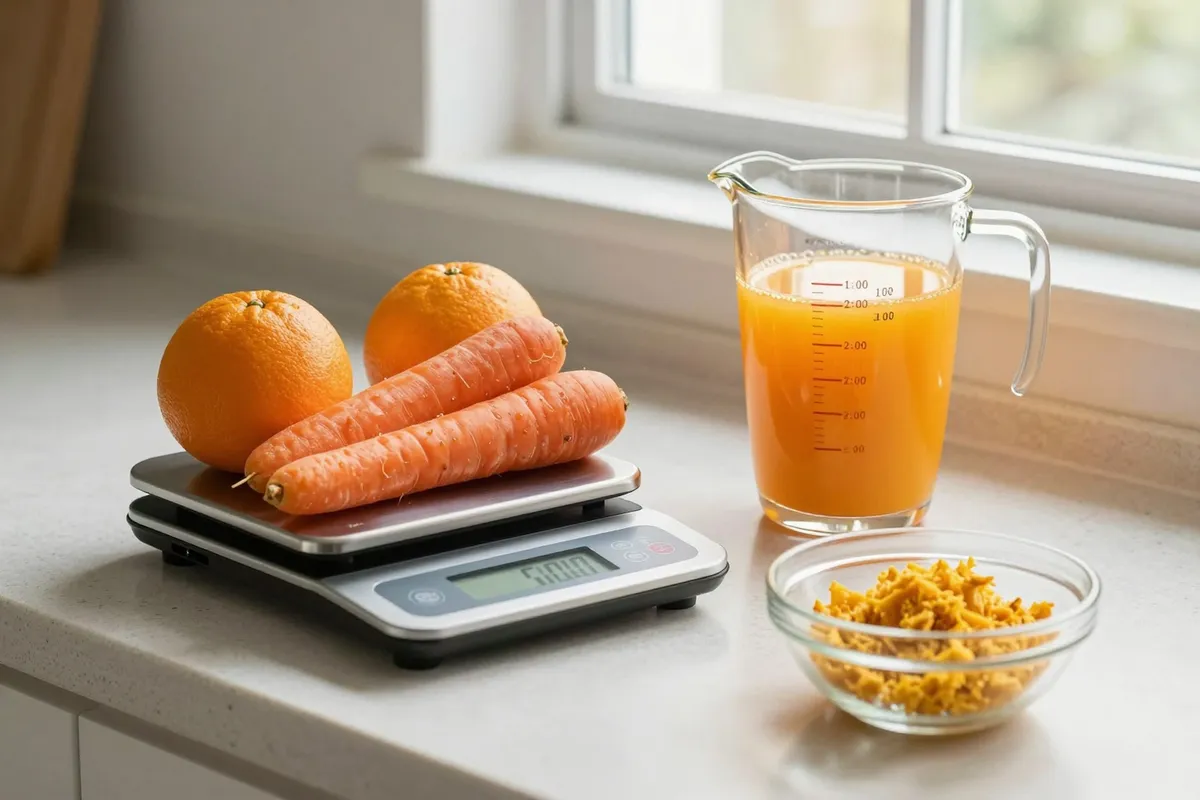
Juice yield & batch cost reference chart
Estimated juice extraction per 1 lb (454 g) of fresh produce based on USDA FoodData Central edible-portion profiles and typical home juicer recovery. Actual results swing roughly ±10% with ripeness and variety.
| Produce | Yield % (Mast. vs Cent.) | Masticating / 1 lb | Centrifugal / 1 lb | Buy for 16 oz bottle | Typical produce price |
|---|---|---|---|---|---|
| Orange | 52% vs 48% | 8.0 fl oz (236 ml) | 7.4 fl oz (218 ml) | 2.0 lb | ~$1.50/lb |
| Apple | 68% vs 62% | 10.5 fl oz (310 ml) | 9.5 fl oz (280 ml) | 1.5 lb | ~$1.60/lb |
| Carrot | 58% vs 52% | 8.9 fl oz (262 ml) | 7.9 fl oz (235 ml) | 1.8 lb | ~$1.40/lb |
| Celery | 74% vs 64% | 11.4 fl oz (337 ml) | 9.9 fl oz (292 ml) | 1.4 lb | ~$1.50/lb |
| Kale | 49% vs 37% | 7.5 fl oz (223 ml) | 5.7 fl oz (167 ml) | 2.1 lb | ~$3.00/lb |
| Spinach | 55% vs 41% | 8.4 fl oz (247 ml) | 6.3 fl oz (186 ml) | 1.9 lb | ~$3.50/lb |
| Cucumber | 77% vs 72% | 11.9 fl oz (351 ml) | 11.0 fl oz (327 ml) | 1.3 lb | ~$1.40/lb |
| Watermelon | 82% vs 77% | 12.6 fl oz (374 ml) | 11.8 fl oz (348 ml) | 1.3 lb | ~$0.95/lb |
| Beet | 58% vs 52% | 8.9 fl oz (262 ml) | 7.9 fl oz (235 ml) | 1.8 lb | ~$2.00/lb |
| Pineapple | 62% vs 57% | 9.5 fl oz (280 ml) | 8.7 fl oz (259 ml) | 1.7 lb | ~$1.80/lb |
| Lemon | 42% vs 38% | 6.4 fl oz (189 ml) | 5.9 fl oz (174 ml) | 2.5 lb | ~$2.20/lb |
| Ginger | 53% vs 47% | 8.1 fl oz (238 ml) | 7.2 fl oz (213 ml) | 2.0 lb | ~$4.50/lb |
How to calculate juice yield and cost per bottle
Every calculation in the tool above uses three transparent kitchen formulas so you can verify a recipe or grocery budget before you buy:
- Convert produce weight to grams: Multiply pounds by 453.59 (or kilograms by 1,000).
- Apply the extraction rate: Multiply weight in grams by the produce and machine yield factor (for example, 58% for carrots in a masticating juicer vs. 52% in a centrifugal juicer) to get total milliliters, then divide by 29.5735 for fluid ounces.
- Divide into bottles and cost: Divide total yield by your bottle size (e.g., 16 fl oz or 500 ml) to find bottle count, then divide total produce spend by bottle count to find your exact cost per bottle.
Masticating vs. centrifugal juicer yield comparison
Whether a slow cold-press machine pays for itself depends directly on what you juice most often:
- Leafy greens & celery (biggest gap): Masticating augers crush cell walls slowly and press out 15% to 33% more liquid from kale, spinach, parsley, and celery. See our best juicer for leafy greens and best juicer for celery guides.
- Carrots, apples & beets (moderate gap): Cold-press machines typically recover 8% to 12% more juice with less foam, while wide-chute centrifugal machines save 3 to 5 minutes of chopping time per batch. Compare models in best cold-press juicers and best centrifugal juicers.
- Watery produce & peeled citrus (smallest gap): Cucumber, watermelon, and peeled oranges yield nearly as well on a centrifugal machine (within 5% to 8%).
How to lower your homemade juice cost per bottle
- Anchor blends with high-yield, low-cost bases: Cucumber (75% yield), celery (70% yield), and carrots (55% yield) stretch expensive herbs, berries, and ginger without watering down flavor.
- Batch prep safely in 12–16 oz glass jars: Follow our batch juicing guide, glass juice bottles shortlist, and weekly juice grocery list to cut produce waste.
- Mix multi-ingredient recipes: Need to combine several fruits and vegetables in one run? Switch to our multi-ingredient produce yield calculator or browse 230+ home juice recipes.
FAQ
How much juice do you get from 5 lbs of oranges or apples?
About 39.9 fl oz (1179 ml) from 5 lb of oranges on a masticating juicer, or about 52.4 fl oz (1549 ml) from 5 lb of apples — roughly 2.5 to 3.3 standard 16 oz bottles.
Does a masticating juicer really yield more juice than a centrifugal juicer?
Yes, especially on leafy greens and fibrous stalks. Slow masticating juicers press 15–30% more juice from kale, spinach, and celery, and roughly 7–12% more from apples, carrots, and beets than high-speed centrifugal blades.
How much does it cost to make a 16 oz bottle of fresh juice at home?
Most homemade 16 oz bottles cost between $1.60 and $3.75 in produce depending on ingredients and season — typically less than half the price of a $7–$10 store-bought cold-pressed bottle.
How many pounds of carrots or celery do I need for 16 oz of juice?
Plan on about 1.8 lb of carrots or 1.4 lb of celery for one 16 fl oz bottle on a masticating juicer (add ~10% more produce if using a centrifugal juicer).
Why does leafy green yield drop sharply in a centrifugal juicer?
High-speed centrifugal blades fling thin kale and spinach leaves against the mesh basket before they can be fully crushed, leaving wet pulp and lower liquid recovery compared with a slow single-auger or twin-gear press.
What bottle size is best for batch juicing and meal prep?
12 oz to 16 oz airtight glass bottles filled to the brim work best because they leave minimal oxygen headroom in the fridge, helping fresh juice keep for 24–48 hours.
Juice and produce pages are general kitchen information only. They are not intended to diagnose, treat, cure, or prevent any disease. Talk with a clinician for personal health questions.
Homemade juice is unpasteurized. Wash produce under running water, keep juice cold, and see the FDA’s juice safety guidance if you are pregnant, serving young children or older adults, or have a weakened immune system.