Best Quiet Blenders for Holiday Hosting & Batch Smoothies
Compare quiet sound-enclosure blenders for holiday hosting (62–88 dBA), RPM/wattage specs, 64–72 oz batch capacity, and frozen-fruit vortex tips.
Interactive Pre-Purchase Check
Before You Buy: Kitchen Fit Checklist
Quick answer
For holiday hosting and early-morning smoothies without drowning out kitchen conversation, pick either a hinged sound-enclosure blender (~62–72 dBA under load) or a heavy elastomer-damped 64-to-72-oz pitcher blender (~73–81 dBA on cushioned feet). Both drop perceived loudness by roughly half compared with unshielded high-RPM blenders that spike to 85–92 dBA on frozen cranberries or ice. Size the pitcher at 64–72 oz so one cycle serves 6 to 10 guests cleanly, layer liquids below frozen fruit for an uninterrupted vortex, and run your produce ratios through our multi-ingredient juice yield calculator and yield and batch cost calculator before hosting.
Acoustic reality for holiday kitchens (dBA, RPM & wattage)
Perceived blender volume depends on acoustic engineering—not motor wattage stickers. According to the CDC/NIOSH occupational noise chart, normal kitchen conversation sits near 60 dBA, and every 10 dBA jump sounds roughly twice as loud to the human ear. An unshielded 24,000-RPM ice crusher hitting 88–90 dBA forces guests to stop talking across a kitchen island, whereas a sealed polycarbonate shroud plus silicone motor mount keeps pitch and resonance closer to a running dishwasher or range hood.
| Blender Architecture | Measured Noise (Frozen Load) | Motor Wattage & Peak RPM | Working Batch Capacity (6–10 Guests) | Countertop & Enclosure Notes |
|---|---|---|---|---|
| Full Sound-Enclosure Blender (Hinged Shroud) | 62–72 dBA (conversation-friendly) | 1,200–1,800W · 18,000–24,000 RPM | 64–72 oz pitcher (~56–64 oz usable = 7–10 pours) | Polycarbonate hood adds ~2–3 in height; check 18-in US upper-cabinet clearance |
| Damped High-Torque Pitcher Blender | 73–81 dBA (muffled low-pitch hum) | 1,000–1,500W · 14,000–22,000 RPM | 64 oz wide-base Tritan (~54 oz usable = 7–9 pours) | Silicone drive socket + heavy cast/rubber base reduces granite counter rattle |
| Unshielded High-RPM Smoothie Blender | 84–92 dBA (piercing whine on ice) | 1,100–1,600W · 22,000–28,000 RPM | 48–64 oz pitcher (~40–54 oz usable = 5–8 pours) | Thin plastic housing amplifies high-frequency blade chatter and countertop resonance |
| Compact Personal Cup Blender | 76–84 dBA (brief 35-sec bursts) | 600–1,000W · 18,000–21,000 RPM | 16–24 oz cup (~14–18 oz usable = 2 pours max) | Great for studio gifting, but awkward for 6–10 holiday guests due to multi-batch rinsing |
Notice the RPM tradeoff: ultra-high peak RPM (26,000+ RPM) creates high-pitched acoustic whine and friction heat without automatically improving smoothness. A lower-pitched 14,000–20,000 RPM motor paired with asymmetric laser-cut blades and strong low-end torque pulls dense greens and frozen berries smoothly into the blade vortex at noticeably fewer decibels.
Batch pitcher capacity math for 6 to 10 holiday guests
Nothing stalls a brunch or Thanksgiving morning like running four noisy 16-ounce cycles while guests wait for refills. Because blending expands liquid with micro-air and ice volume, you can safely fill a 64-oz pitcher to the 56–60 oz working line and a 72-oz pitcher to the 64 oz line without blowing the center cap.
- 6 guests (6–8 oz smoothie or strained juice pours): Total target = 36–48 oz. A single cycle in a 64-oz pitcher covers everyone at once with zero second batch needed.
- 8 to 10 guests (6–7 oz party pours or mocktail bases): Total target = 56–64 oz. Choose a 64-to-72-oz wide-base pitcher filled carefully to its max liquid mark; if you plan to blend and strain holiday punch via our blender-and-strain method, split into two calm 45-second cycles over a fine-mesh nut-milk bag so the lid seal stays dry.
- Why pitcher width matters: Wide-base 64-oz jars pull leafy spinach, kale, and chopped apples downward quickly, whereas tall narrow 48-oz jars trap frozen fruit bridges near the top unless you constantly pulse and scrape.
Frozen fruit vs. fibrous greens vortex tips (zero cavitation)
Most unnecessary blender noise happens when blades spin in an empty air pocket—called cavitation—screaming at 88+ dBA while whole frozen berries float untouched above the blades. Build your holiday batch in strict density layers so the vortex engages within three seconds:
- Layer 1 (Bottom — Cold Liquid Base, 1.5 to 2.5 cups): Pour chilled apple cider, coconut water, oat milk, or cranberry orange juice first so blades sit fully submerged before starting.
- Layer 2 (Lower Middle — Soft Produce & Herbs): Add peeled cucumber, spinach, mint, or cored pears right above the liquid so blades shred fibrous greens into a smooth slurry before ice hits them.
- Layer 3 (Upper Middle — Fresh Apples, Carrots & Ginger): Chop firm carrots and ginger into ¼-inch coins if your blender runs below 1,200W so dense chunks never bounce noisily off Tritan walls.
- Layer 4 (Top — Frozen Cranberries, Mango & Ice Cubes): Frozen ingredients sit on top, pressing soft greens downward into the blade funnel rather than wedging underneath.
- Ramp Speed 1 → Speed 7–8 gradually: Never slam straight onto High/Pulse with frozen fruit; a 4-second soft-start ramp lets the vortex form quietly and protects the drive clutch.
How to test & quiet any blender during holiday hosting
- Place a ¼-inch silicone counter mat or folded bar towel directly under the blender base before plugging in—decoupling hard rubber feet from granite or quartz countertops drops transmitted rumble by 3–5 dBA immediately.
- Measure upper-cabinet clearance (standard US counters have 18 inches); confirm a sound-enclosure hood opens fully at the back of your counter without hitting cabinet trim.
- Load ingredients in liquid → greens → fresh produce → frozen fruit order, lock the vented lid and tamper sleeve securely, and verify the center cap sits tight (never blend hot soup in sealed personal cups).
- Start on Speed 1–2 for 5 seconds until the vortex pulls frozen fruit downward, then step up smoothly to Speed 7–8 for 35–45 seconds while guiding corners gently with the tamper.
- If preparing strained fruit-and-herb juice ahead of dinner, pour through a fine-mesh straining bag into airtight glass carafes, refrigerate at 40°F (4°C) or below per FDA raw juice safety guidance, and check baseline nutrient profiles on USDA FoodData Central.
- Rinse the pitcher within two minutes using warm water and one drop of dish soap pulsed at low speed for 15 seconds—keeping holiday cleanup quiet and under 60 seconds.
Blending vs. juicing for holiday crowds
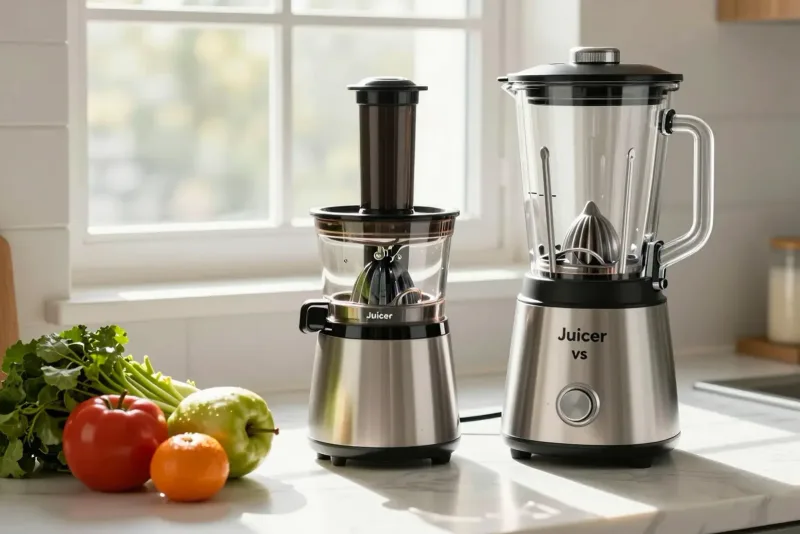
Still deciding whether a quiet blender or a slow masticating juicer fits your hosting schedule best? Compare texture, noise, and prep time in our juicer vs. blender comparison, check our holiday kitchen gift guide under $200, or read best quiet juicer and how to keep a juicer quiet. Whenever you publish or cite gear specs, we follow the transparent verification process outlined in our Editorial Policy.
Mistakes to avoid
- Buying on peak wattage instead of enclosure & base weight: A hollow 1,500W plastic base rattles far louder than a heavy, cushioned 1,000W motor with a tight sound shield.
- Dumping frozen cranberries directly onto dry blades: Frozen berries lock blades instantly, spike amperage, and cause loud air-pocket screeching until liquid reaches the bottom.
- Ignoring sound-shield height under upper cabinets: Many hinged enclosures measure 19–21 inches when flipped open and cannot sit tucked beneath 18-inch US cabinets.
- Blending hot holiday soups in locked single-serve cups: Steam pressure builds inside unvented personal cups; always use a vented full pitcher with a folded towel over the center plug.
- Skipping counter isolation: Running a blender directly on hollow butcher-block or stone islands turns the whole countertop into a speaker cabinet.
Estimate yield & cost: Compare masticating vs. centrifugal output, bottles per batch, and cost per serving in our Juice Yield, Produce Weight & Batch Cost Calculator, or combine multiple ingredients in our Multi-Ingredient Juice Yield Calculator.
FAQ
Can a quiet blender make pulp-free juice for Thanksgiving and holiday mocktails?
Yes. Blend chopped fruit, herbs, and a splash of cold water until smooth, then pour the puree through a fine-mesh nut-milk bag or chinois strainer. You lose only a couple minutes versus a juicer while keeping early-morning prep flexible.
Why does my blender scream loudly when blending frozen fruit and kale?
That screech is usually cavitation—an air pocket trapped around spinning blades while frozen fruit bridges above them. Load liquid at the bottom, followed by greens, then frozen fruit on top, and ramp up slowly from Speed 1 instead of jumping straight to High.
Does a silicone mat actually lower blender noise on granite counters?
Yes. A ¼-inch dense silicone mat or folded kitchen towel decouples hard base vibration from stone or wood counters, cutting low-frequency countertop hum by roughly 3 to 5 dBA immediately.
Should I buy a quiet blender or a cold-press juicer for holiday entertaining?
Buy a quiet blender if your guests want frozen berry smoothies, creamy pumpkin or squash soups, oat-milk drinks, and occasional strained punch. Buy a cold-press juicer if your household prioritizes clear, pulp-free carrot, apple, celery, and ginger juice bottled for 48–72 hours.
Try these recipes
- Cranberry Orange Juice Recipe
- Green Juice Recipe
- Apple Lemon Ginger Juice Recipe
- Carrot Orange Juice
- Pomegranate Orange Juice Recipe
Explore: Juicer buying guides · Juice recipes · Green Juices · Carrot Juices · Beet Juices · Celery Juices · Citrus Juices · Tropical Juices · Berry Juices · Juice Shots · Eat the Rainbow · Red Juices · Hydration Juices · Meal-Prep Juices · Orange & Yellow Juices · Winter Juices · Purple Juices · Summer Juices · White & Brown Juices
Buying criteria only — not lab-tested rankings unless a page explicitly says otherwise. Read our Editorial Policy and Medical & Food Safety Disclaimer. Kitchen content is not medical advice.